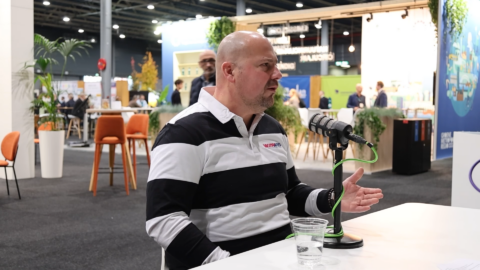
Vincent Hendriks has been giving concrete a second life for quite some time now. He continues his recycling drive unabated. Now he’s setting his sights on ZOAB. “You’ll never pull it off…”
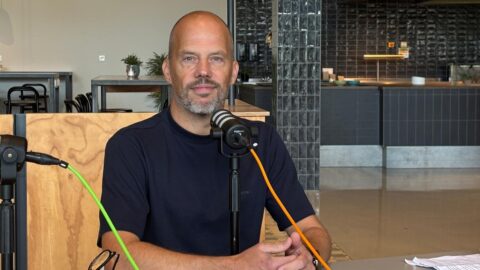
Vincent Hendriks is the fourth generation of Hendriks in the more than 100-year-old construction company of the same name in Oss. But for recycling concrete, he’s set up his own side business. He spent seven years developing the process, and now the concrete from NXT Building consists entirely of recycled material—including the cement. That cuts CO2 emissions by a huge amount, assures Hendriks, who devised the process.
His demeanor combines bravado with a down-to-earth pragmatism. Once he sets his mind on something, he doesn’t let go. “Of course you run into all kinds of things, but you just have to persevere,” he says. “A lot of people give up too quickly when they’re developing something. They don’t see it through—I don’t know why that is. There’s always a solution.”
Urban mining
With that mindset, he started working on circular concrete eight years ago. “I was talking with some acquaintances about circularity, and together we sketched out a machine that could do it. It would be great if that machine were built, we thought—then we could get into urban mining.”
Vincent was the one who took the initiative. “First, we worked with a professor to build a small model and patent it. That didn’t work. By then, we already had a whole process in mind. First, we break the old concrete down into gravel. Then it goes into a high-speed rotating machine. We use a sieve to separate the coarse and fine fractions, and we use the sand to sandblast the rest.”
Support during demolition
In the end, it took them seven years to develop and refine the process. “But now we’re making the most sustainable concrete in the Netherlands,” Vincent says proudly. “We supply all the major and small contractors in the area, including those in the precast sector. We also supply Volkel, the air force base, right here in the area. They’ve got their F-35s there, so CO2 is a problem for them. Thanks to those carbon credits, we’re making sustainability affordable.”
Concrete is the hardest to recycle, he continues. “It contains steel and wood.” That’s why NXT Building is already on site during demolition to oversee the process. “If you don’t do that, it won’t turn out right. We’re quite adamant about that.” He recalls that a demolition company once delivered a batch of concrete to him that he couldn’t use because it was too contaminated. “Then you’re stuck with it, and it costs you money to get rid of it.”
And then there’s asphalt
After his success with concrete, Vincent got the hang of it and turned his attention to asphalt. With his knowledge of concrete and ceramics, he was sure he could find a way to reuse that, too. “You’ll never pull that off,” they told me.
So NXT Building is now also recycling old ZOAB. “With ZOAB, bitumen is the problem. Hold a flame to it, and you get emissions. If the bitumen content is above one percent, you’ll see it in the chimney. To get below that threshold, we reduce it to a very small fraction. Then we clean it, screen it, and wash it. No chemicals—it’s very clean.”
Not all types of asphalt can be recycled, Hendriks emphasizes. “We can’t do anything with asphalt that contains tar. So you have to be there during the harvesting process—during milling. We have very strict acceptance criteria. But that’s why we pay for it.”
Keep pushing forward
And now Vincent has also set his sights on infrastructure bricks, the well-known street pavers. “We make the mixtures and deliver them to the factory. And we’re going to do the same for roof tiles and facade bricks.”
“We’re just plowing ahead,” he continues in his typically matter-of-fact manner, but with a twinkle in his eye. And it shows. Because NXT Building is currently expanding significantly. The site in Oss where they were located had become far too small, so Hendriks purchased a large plot of land—4 to 5 hectares—a short distance away. They’re now building there.
As a result, production has been on hold for a few weeks at the time of this interview, but that’s not a problem. “We ran the line a lot before the holidays, so we have plenty in stock. Because when Geelen comes and wants something, we have to deliver. And production in the new facility is ramping up to full capacity. We’re growing rapidly. More and more people are asking us for quotes. That’s how we’re becoming the largest center for circular raw materials.”