There’s a rule that isn’t written down anywhere, but is applied in virtually every successful pilot. I call it the fifth commandment. The proverb that goes with it is “turning a blind eye.” You see what’s happening, but decide not to scrutinize it too closely for the time being because you understand that intervening at that moment would not promote success.
In the Netherlands, we’ve coined the term “tolerance” for this. In many other countries, they take steps in advance to ensure that legislation doesn’t become too restrictive for those implementing it. Unfortunately, “tolerance” has since taken on a somewhat questionable connotation. It sounds as if the government doesn’t have something under control or doesn’t dare to take action. However, “tolerance” also serves a very practical purpose. Rules are, after all, made for the reality we know. When that reality changes, the rules don’t change immediately. This creates a situation where old rules still apply, but the new practice no longer fits within them. The problem that arises is that the new practice is held back because we believe the entire system must first be adapted to it.
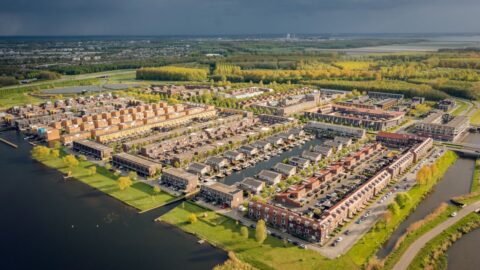
Grid congestion illustrates this point well. In more and more places, new homes can no longer be connected to the power grid in the usual way. We tend to think that the solution lies primarily in laying more cables, installing heavier transformers, and building new substations.
But there’s another way to approach the problem. New homes use relatively little energy, generate their own electricity, and are increasingly able to manage their energy consumption using smart technology. If you link generation, storage, and demand at the neighborhood level, you’ll need far less capacity from the public grid than if every home had to be able to use its maximum power at any given moment. Technically speaking, this is by no means a new innovation. Yet it isn’t happening because our system is built around individual connections, fixed responsibilities, and a grid operator that must provide sufficient capacity for each connection. As soon as an area begins to function as a single energy system, you quickly run into legal and institutional constraints.
You could then wait until legislation, oversight, responsibilities, and market regulation have been fully adapted. But by the time all that is settled, years will have passed. That’s where the Fifth Commandment could be helpful.
Not by sweeping the rules aside en masse, but by making room for a solution that everyone understands is technically feasible, socially desirable, and does not pose any unacceptable risks—even if that solution does not yet fit neatly within the existing framework. Although we’ve already neatly regulated district heating networks at the regional level. What’s new?
At my former employer, the Steering Group for Public Housing Experiments, we were quite good at that back then. Around these experiments, a temporary alternative reality was created. People were given the space to first demonstrate that something worked, and only then did they figure out how to integrate it into the system on a structural basis. In my opinion, we could apply that approach more often outside of pilot projects.
Network congestion is just one example. A housing development project involves multiple systems simultaneously: water, nitrogen, nature, noise, soil, mobility, energy, and affordability. Each system has its own rules and responsibilities. Individually, these are often quite understandable, but together they ultimately ensure that nothing gets done.
The water authority makes a sensible decision based on water management interests, the province based on nature conservation, and the grid operator based on the electricity grid. The municipality follows its rules, and the developer tries to comply with everything. Everyone is doing their job, and yet construction isn’t happening.
The resulting response is usually more roundtable discussions, more program managers, acceleration teams, and integrated decision-making frameworks. While this can sometimes help, each participant remains at the table representing their own system. As a result, the underlying problem simply persists.
In that case, you have to go beyond mere coordination. You have to dare to decide that a rule carries less weight temporarily if it blocks another socially desirable solution. Of course, this doesn’t apply to everything. Safety, equality before the law, and fundamental interests are different from rules that primarily codify how we once organized the system. We treat them the same way far too often.
This hinders change. The same applies to collaboration, by the way. We constantly urge parties to look beyond their own boundaries, yet in the meantime we have firmly anchored those boundaries in laws, jurisdictions, funding streams, accountability rules, and oversight. Then we’re surprised that people don’t easily step over them.
There is a strong call for boldness, enterprising civil servants, leaders who take responsibility, and companies that try new things. But as soon as someone actually steps outside the lines, the question quickly follows: where does it say that’s allowed?
An even better question is: what public interest are we protecting if we do not allow this? When we allow for a rule to be temporarily set aside—rather than applied to the letter—it must be clear why we are doing so, what societal interest is served by this, and which interests must under no circumstances be harmed. But the starting point shouldn’t always be that the entire system must change first before anyone is allowed to do something differently. After all, when it comes to systemic problems, you won’t solve them by refining the system even further. Often, you have to leapfrog the problem to arrive at a solution.
Sometimes, just spreading your fingers a little is enough to make progress.