Our industry is changing rapidly. Digitalization, sustainability, labor shortages, mergers and acquisitions, and a new generation in the workplace. We need to start working differently in this industry. But working differently requires more than just a new strategy or a different process. It requires a different mindset. It calls for new ways of collaborating, communicating, and leading. In short: it requires a different culture.
Last time, we talked about Barli, which grew from 40 to 250 employees thanks to a cultural shift. This month, we’re sharing another story from our book *Building Culture Through Change*: that of Knaapen, the oldest family-owned business in Brabant.
At Knaapen, the focus wasn’t on growth, but on sustainability. The goal: to be carbon-neutral and circular by 2040. Here, too, it became clear that achieving an ambition is only possible if the entire organization is on board.
Bottom-up
Director Bart Knaapen leaves no room for misunderstanding: “Sustainability isn’t something we just ‘do on the side.’ If you haven’t made huge strides toward sustainability in five years, your company has no future in our industry.”
Still, at Knaapen, sustainability was initially mainly the responsibility of the management team. Solar panels, electric vehicles. Great initiatives, but fragmented and top-down. Sustainability Manager Sandra Zomervrucht reached the conclusion that set everything in motion: to truly embed sustainability in the company culture, it had to be a bottom-up effort, not a top-down one.
A network of change agents
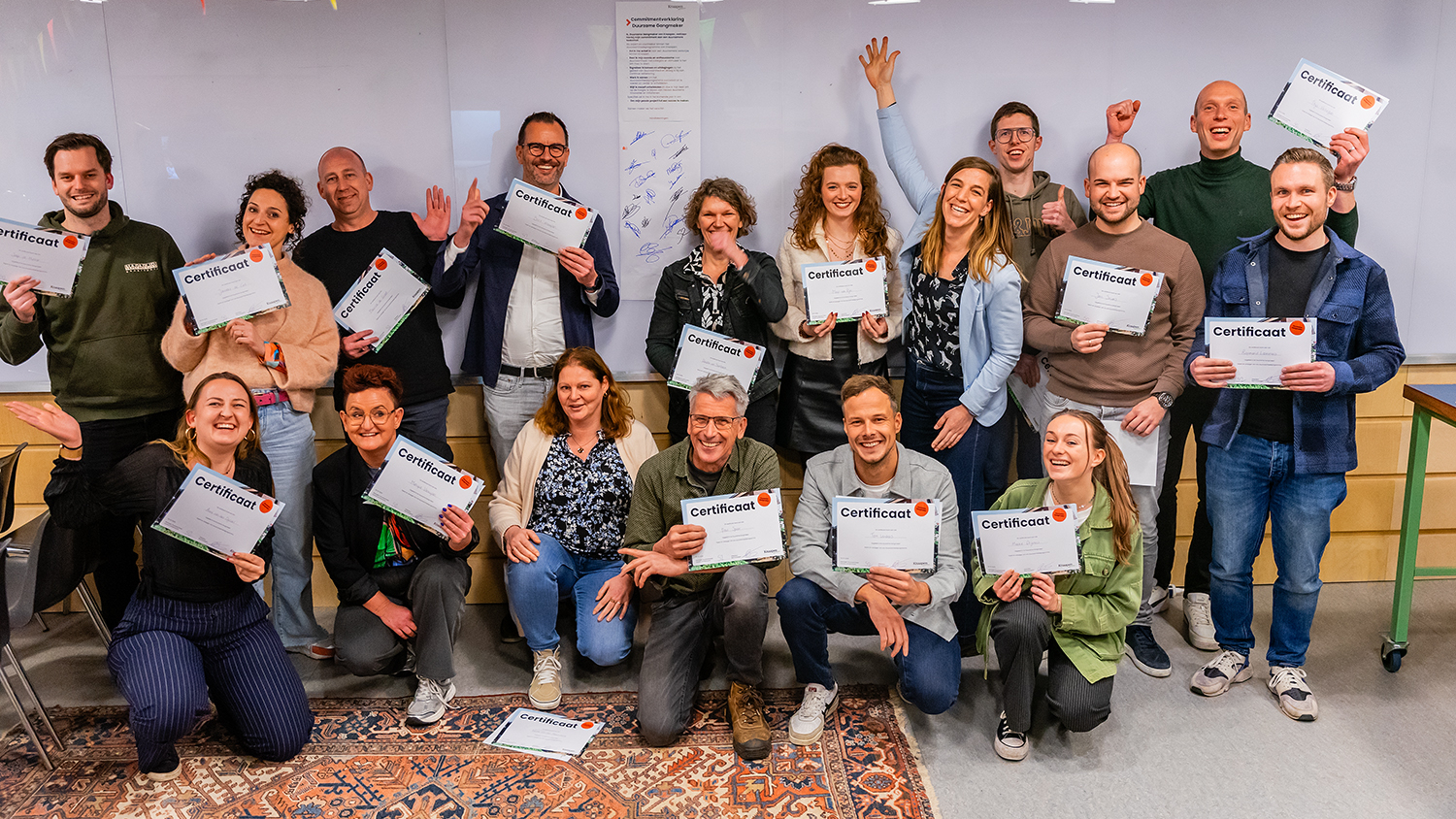
In 2023, Knaapen called for “Sustainability Pioneers”: in-house drivers of sustainability, spread across all departments. Twenty-eight colleagues signed up. Together, they participated in five sessions, each dedicated to a sustainability theme: from smart use of materials to energy-efficient work practices.
Sustainability consultant Anna van den Dijssel: “It wasn’t just about learning the subject matter. It was also about how to fulfill your role as a change agent. It takes courage to initiate change and speak up to colleagues.”
Each session for the change agents coincided with a theme week for the entire organization. For example, a “bike-to-work” day, with a colleague who bikes to work every day serving as the figurehead. In this way, sustainability didn’t become a rule imposed from above, but rather a behavior driven by the people themselves—and that is exactly what cultural change is all about in practice.
From Idea to Passion Project
Each session ended with a brainstorming session: What can you do? What does Knaapen need to do? Ultimately, each “Gangmaker” chose their own Passion Project and signed a letter of intent for it. This led to the creation of a tool for planning maintenance routes more efficiently, the integration of sustainability into performance reviews, and Anna’s development of the internal web store KnaapenKiest—where the environmental cost, not the price in euros, is the deciding factor.
The director is also getting involved himself
Bart Knaapen himself also became a “Gangmaker.” “I had my doubts, because the dynamics in a group change when the director is present. But I feel I have a role model function.”
Anna: “Setting an example is very important. You can tell that the management is intrinsically motivated.”
Bart adds: “We employ a ton of specialists who know better than I do. This would never have worked if it had been imposed from the top down. Imposing something like that just doesn’t work.”
Clear and concrete
What helped: hard numbers and concrete annual goals. When Knaapen stopped using plastic cups, the company first calculated how many were used annually: 300,000. “Figures like that really shock you,” says Bart, “and then our colleagues understand why we’re phasing them out.”
Not everything works out
Change like this never happens on its own. There’s always resistance. Not everything works out. Even at Knaapen, some change agents dropped out along the way. Knaapen focuses mainly on what does work. Sandra: “We don’t want to force it either. Intrinsic motivation takes time.” The ultimate goal of her own department: to eventually become unnecessary, because sustainability will then be woven into everything.”
From the inside out
What appeals to us about Knaapen’s story is that sustainability here didn’t start with technology, but with people. Of course, solar panels, electric equipment, and circular materials are important. But ultimately, it’s the employees who determine whether a sustainability goal actually becomes a reality.
This is clearly reflected in the choice of “Sustainability Pioneers.” It’s not the executive team coming up with all the ideas, but colleagues from across the organization who bring others along and inspire one another. This ensures that sustainability isn’t just a project for one department, but a commitment for the entire organization.
At the same time, Knaapen shows that cultural change requires patience. Not everyone gets on board, not every initiative succeeds, and even change agents drop out along the way. That’s just part of the process. It is precisely because there is room for that reality that the change remains credible.
For us, this is yet another great example of something we see in many organizations: sustainable change doesn’t happen because people are forced to change, but because they themselves become part of the change.
You’ve read the short version of the interview with Knaapen, as published in the book *Building Culture in Times of Change*: www.bouwenaancultuur.nl
About “From the Inside Out”
Combined, Inge Sijpkens and Sascha Murk have been working in construction and engineering for over forty years. During that time, they not only worked at and with numerous companies in the industry, but they also interviewed many of them. For their books alone, they conducted more than 100 interviews. What they learned: in our “hard” industry, it’s actually the “soft” things that make the difference in how successful you are as a company—especially during a period of major change. Success starts from within.