The strict regulations for affordable housing are having the opposite effect. The solution? As a country, we must first ensure that housing construction plants get up to speed; lower prices will follow naturally.
The Netherlands wants to build faster, build more cheaply, and build affordably. That’s three goals. Standing between these goals and their realization are the factories that must account for at least fifty percent of that production by 2030.
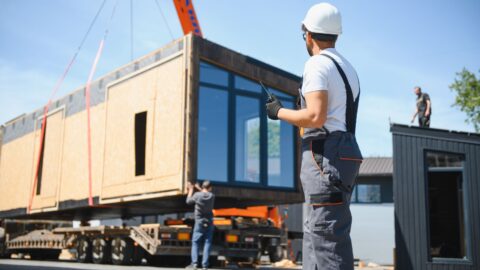
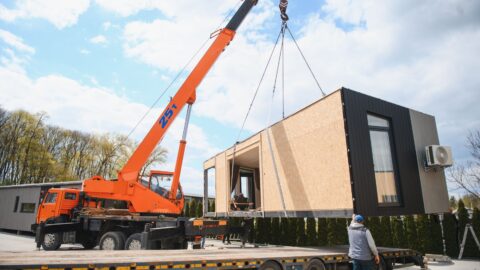
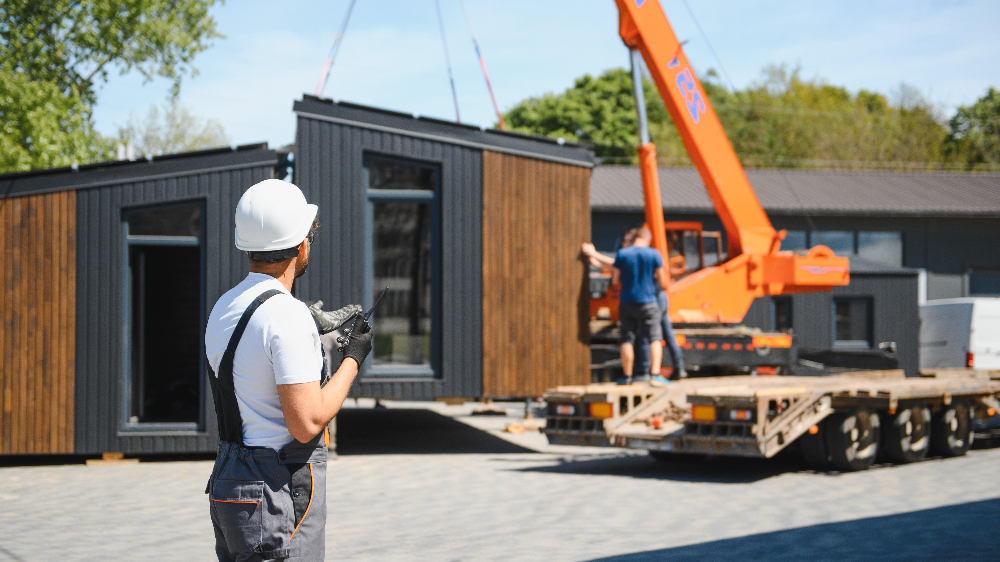
Industrial construction can produce homes faster and with less labor. Costs can be reduced as designs are repeated and production lines are utilized more efficiently. However, a home factory isn’t like a faucet you can turn on as soon as a permit is issued. The facility, machinery, software, and staff cost money every day—even when nothing is rolling off the assembly line.
The Economic Institute for Construction applied that mechanism to a 100-million-euro factory (EIB, 2023). In that example, with 500 homes per year, the fixed capital cost amounted to approximately 23,500 euros per home. With 2,000 homes, it was 6,000 euros, and with 4,000, it was just 3,000 euros. A crystal-clear lesson for everyone: without a continuous flow of orders, the cost advantage evaporates.
Without projects, no affordable housing is built. However, projects won’t move forward if the financials don’t add up. Sometimes this is due to grid congestion, objections, nitrogen emissions, or infrastructure issues; a different housing mix won’t solve those problems. However, project developers are increasingly telling me that, for some projects, it is precisely the mandated share of regulated housing that is the final obstacle. In such cases, we cling to a percentage at the project level, while a potential contract for the construction company remains elusive.
Being unable to build is, then, a rather peculiar form of affordability policy. After all, a project that is two-thirds affordable but never gets off the ground yields zero homes. Sixty or sixty-five percent of a project that does get underway produces actual homes and provides a manufacturer with the order needed to make the next batch cheaper and future projects more feasible. So the question isn’t whether we should abandon affordability. The question is how we can factor in time and reward faster construction.
To illustrate the impact of time, I used the size distribution of fifteen larger housing projects from a public municipal list for a sample calculation. The number of homes is based on actual figures; the financial feasibility limits are model assumptions and therefore do not constitute a judgment on the actual projects.
For the sake of this example, I’ll assume that four projects—representing two-thirds of the affordable housing quota—can be started immediately. If there is room for up to about 60 percent, five additional projects will be added; if there is room for up to about 55 percent, another three will be added. The remaining projects face other obstacles or would require more space than the cap allows. In the model, projects ready to start are completed in year three, and pending projects in year eight. Sixty percent of the early construction volume is potentially suitable for industrial production. The trade-off does not have to be compensated on a one-to-one basis with another project. The decisive factor is whether the adjusted mix demonstrably results in more affordable housing within five years than sticking to a standard under which the project would not start.
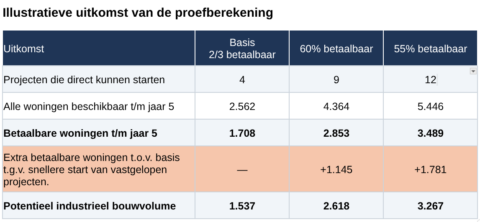
The interesting figure is the 1,781 homes that, in this simulation, will become available as additional affordable housing within five years by adjusting those percentages—not by abandoning the public goal, but by taking advantage of opportunities to accelerate progress. The double benefit lies in the fact that construction firms can also step up their efforts, making it increasingly easier to achieve future goals.
The model shows which questions need to be answered: Which project fits which mix? What is the minimum adjustment required? What is the firm start date? And what production capacity has been reserved? Call it a realization trade-off: space on one project, exclusively in exchange for a demonstrable construction start date and a guaranteed public benefit.
The conditions:
-
t
- An independent assessment compares two business plans. The current mix is demonstrably unsustainable; the minimally adjusted mix is not.
- All other obstacles have been resolved. Land acquisition, design, financing, grid congestion, and permit applications are all in order; the construction site has been reserved; and foundation work will begin within twelve months.
- The pilot program has a cap per project and for the annual program. No start means no benefit; a bank guarantee covers the risk.
t
t
This isn’t a free market based on polite requests. It’s a business transaction with a public ledger. If we do this for five years, for example, the construction industry will have time to get its industrial production in order, and it will then be much easier for the government to impose stricter requirements. After all, by that point, the factories will be delivering the affordable solutions that are in demand and will be able to act quickly in accordance with the procedures in effect at that time.
The government wants half of all new homes to be built industrially by 2030 and cites larger, repeatable production runs as a prerequisite. Municipalities must align their planning accordingly. Without a full order book, that industrial ambition will remain nothing more than a plan on paper. So we don’t have to choose between speed and affordability. We must make speed part of our definition of affordability.
Define the public outcome. Ensure that the path toward it proceeds in a controlled manner. And only give the construction company leeway if there is a real contract to back it up. A person looking for a home doesn’t live in a percentage. A person looking for a home lives in a home that has been built.