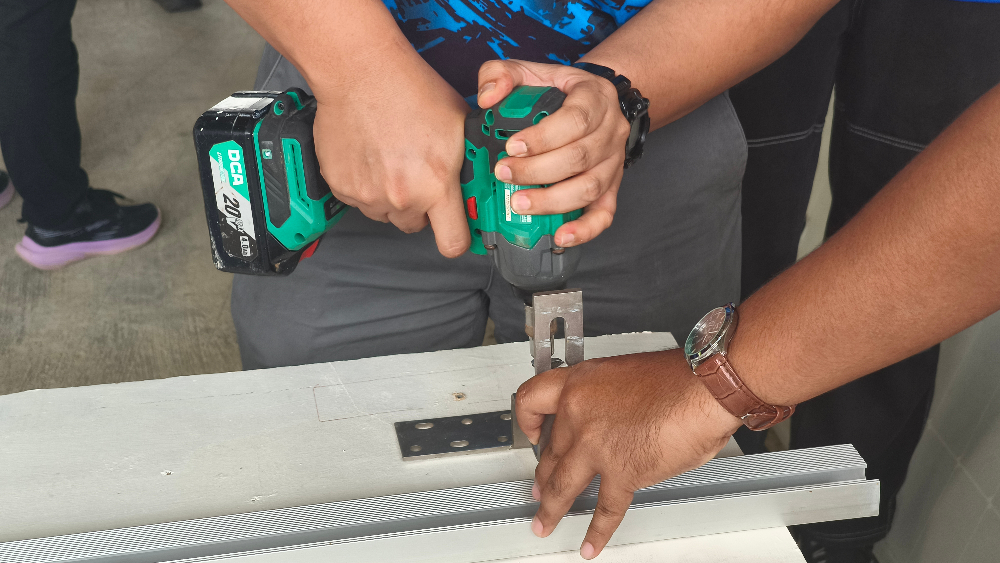
The tech sector is crying out for staff, and it is precisely this staff shortage that threatens to hinder the recruitment of new skilled workers. Companies are so busy that time for mentoring students is becoming increasingly scarce.
At the start of the new academic year, this is a painful paradox: tomorrow’s engineers are desperately needed, but where can they still learn the trade? It’s time to take a closer look at the reality on the ground. How pressing is this problem, and above all: how do we solve it?
Paradox
According to Dick Reijman of Techniek Nederland, there is a clear explanation for this paradox. “Companies are incredibly busy due to an aging workforce and staffing shortages. Technicians and on-the-job trainers have packed schedules and therefore have less time to mentor apprentices. It is precisely the companies that need people the most that often have the least capacity to train new skilled workers.”
According to Techniek Nederland, there is no nationwide figure for the shortage of apprenticeship positions. The situation varies by region and program. However, the trade association notes that not every student looking for an apprenticeship position is able to find one.
Everyone is having trouble finding a placement
When asked, Deltion College in Zwolle explains that, for the time being, it is still able to provide its students in the Technology and Built Environment department with an internship or apprenticeship. The question is, however, for how much longer, as the vocational college also acknowledges that it is becoming increasingly difficult to place everyone.
According to a spokesperson for Deltion College, companies’ capacity to provide guidance is also the main cause. “Skilled workers are desperately needed on the job, and at the same time, we need those same skilled workers to serve as practical instructors or mentors for the next generation. That creates a tension.”
But the training center in the eastern part of the country cites yet another reason. Deltion College is seeing a shift in its incoming student body. “The increasing diversity of the student population sometimes requires more support in the workplace. For example, we’re seeing more students who speak other languages and students who don’t yet have a sufficient command of Dutch when they enroll. It can be more difficult to find a suitable placement, especially for that group—which needs more and more intensive guidance.”
In terms of enrollment, there is a silver lining, albeit a small one. “We’re seeing growth in a number of our technical programs, such as electrical engineering, infrastructure engineering, and mechatronics.” Techniek Nederland also notes a slight increase in the number of new students nationwide. According to the trade association, however, this is by no means enough. Due to an aging population and growing societal challenges, there is a structural need for more young people and career changers.
Looming downward spiral
The solution that is often quickly proposed is “getting more young people interested in technology.” According to Reijman, that is only half the solution. If the capacity to subsequently train them, mentor them, and—above all—allow them to gain hands-on experience does not grow along with the number of students, a new bottleneck will arise.
Reijman therefore warns of a self-perpetuating problem. “If we do nothing, we’ll end up in a downward spiral; we’ll get busier, which means we’ll train fewer and fewer people, which in turn will only make things even busier.”
New, more flexible approaches to training
To stay ahead of these problems, Techniek Nederland sees opportunities in alternative training methods. Reijman: “For example, students could gain experience at multiple companies through regional partnerships, training companies, or joint practical training centers. Smaller companies might be able to share on-the-job trainers with one another. You could also involve upperclassmen in providing guidance.”
Deltion also advocates for more flexible forms of training and closer collaboration between education and the business community. According to the training center, this isn’t just about young people. “Career changers, retraining, continuing education, and lifelong learning are also becoming more important.” According to the school, Bol, BBL, customized programs, and modular tracks will increasingly need to coexist.
Consequences extend beyond the engineering and installation sectors
According to Techniek Nederland, the situation is urgent. Reijman notes that a persistent shortage of technical personnel will ultimately affect more than just construction and installation companies. “Without enough technicians, the energy transition, housing construction, grid upgrades, making buildings more sustainable, climate adaptation, and the replacement of outdated infrastructure will be delayed. Wait times will increase, projects will become more expensive, and companies will have to turn down more work. Ultimately, this will affect not only the technical sector, but also the economy and the societal challenges facing the Netherlands.”
According to both Deltion and Techniek Nederland, the solution requires cooperation between the education sector, the business community, and the government. Companies will need to set aside time and resources for mentoring, the education sector must continue to provide practice-oriented training, and the government must make substantial investments in technical education and the BBL pathway.
Reijman: “If we don’t invest in technical training programs now, the labor shortage will only get worse.” According to him, this also places a significant responsibility on companies that offer apprenticeship positions: “Don’t view training as an extra expense, but as an investment in the future—both for the company and for the entire sector.”