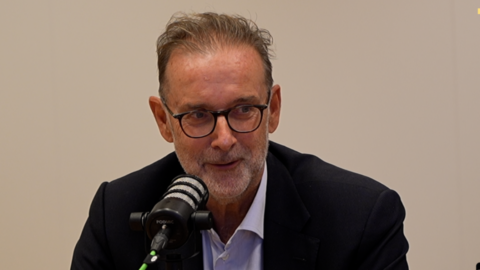
The CO2 emissions for which the construction industry is responsible are not immediately cheerful. Reducing them does, believes Jacqueline Cramer, former minister and chairman of the Concrete Accord. Although she recently stepped down as professor of sustainable innovation, she is not laying off the sustainable axe. "I continue to follow my passion."
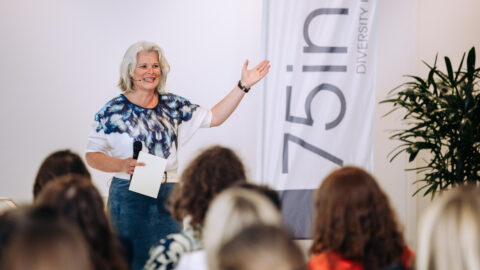
"Cheery construction news? Nice column... I do have cheerful construction news too," thought former minister Jacqueline Cramer when she heard about it. In no time, contact was made with the editors. This time the stage is set for her.
What is your passion?
"Committing myself to the livability of our planet. As an 18-year-old girl, I received a scholarship to study in the United States for a year. To get used to American culture, I stayed with a wealthy family that lived on one of the hills of Los Angeles a month before the start of the academic year. Looking out toward the city, all I saw was a white blanket, and I asked the lady of the house what that was. "Oh, that's just smog because of all our cars," she said. That answer hit me like a sledgehammer blow and I decided on the spot that I wanted to devote my life to environmental issues. And I did. By the way, there was no education in that field back then. I studied biology and took Environmental Studies as a minor. Sustainability has been the common thread in my work for decades, both in politics and in science and business. And now I have been involved in making construction more sustainable for many years, especially as chairman of the Concrete Agreement and Steel Building Agreement."
Why exactly are you committed to the concrete and steel industry?
"Because those sectors are responsible for about 11 percent of global carbon emissions. That really needs to come down. With steel, it's not so much about changing the composition of the material itself - because steel is steel, after all - but about making primary production more sustainable. Further steps are possible through reuse and high-grade recycling and adjustments in designs, for example by using stronger steel. A lot is also happening in the world of concrete. The Concrete Agreement is working hard to achieve a climate-neutral concrete chain. For example, there are already several examples of alternative materials with the properties of concrete, but with a much smaller footprint, or even zero. It is also possible to include CO₂ in concrete. So much is possible, that makes me very happy."
That Concrete Accord dates back to 2018, what is the state of play?
"All the preparatory work has been completed. Now it is time for scaling up and putting innovations into practice. But, the change process is tough. This is because the concrete sector is very regulated and - therefore - conservative. Furthermore, the concrete sector is not given priority in innovation policy. As a result, the incentives to innovate are lacking."
Whose fault is that?
"The grant application we submitted for the concrete sector to the National Growth Fund was not honored. We were told that it is not up to the government to make concrete more sustainable, but to the industry itself. But until now the government regulated the sustainability of the building chain, but not the building materials, such as concrete. We are now trying to regulate that piece ourselves through the Ministry of Infrastructure and Water Management. We expect that new legislation can be introduced in 2027. That will initially apply to civil engineering (GWW), a branch with mostly public clients. So innovation can happen now, but subsidies for innovation can speed things up further in the process."
That process, how does it work?
"We use the so-called Leader-Peloton approach. The knowledge and experience gained by the frontrunners forms the basis for steering the pack at a later stage. The performance requirements become increasingly stringent, but when the frontrunners show that bigger steps are possible, that becomes the measure. In this way, we pull innovation forward and start from what is realistic. The concrete industry and especially the materials suppliers are the first to benefit from the innovations. That's a huge incentive! Think of it as a real race: whoever comes up with the best solution can then be the standard for the whole sector.
It is also an opportunity for investors and other financiers, such as banks.
GWW is leading the way now, but once the system for that is set up and settled, it can be implemented one-to-one for civil and utility construction (B&U). The big advantage is that everyone does the same thing; very clear because then the market will know what to anticipate. In B&U, the proportion of private clients is large; we are working hard to unite those parties in a large coalition. Together we have agreed to steer in the same way as in the GWW, but on a voluntary basis. At the Provada in June we will confirm this with a joint commitment. I would like to draw attention to that."
You may make a call, hear ...
"Well, gladly! If there are parties in the private client sphere in B&U who still want to join, you can. I'm thinking of developers, investors, construction companies, housing associations. They can sign up through the secretary of the Concrete Accord (martinjvandervliet@gmail.com). It takes little time; the preliminary work has all been done. The only condition is that these private clients start prescribing sustainable concrete in their contracts."
Besides the problem of steering, was there another bottleneck?
"Yes, there was no standard that allowed innovation. The regular standard EN206 (standard for application of concrete in constructions, ed.) is based on European standards and prescribes that concrete must consist of x percentage of cement. Cement, in other words. If you want to replace that with another low CO₂ binder, it no longer fits within EN206. We have to deal with things like that. That is sometimes quite frustrating. Fortunately, it turned out that another track could already be deployed and that is called Concrete on Performance. This is not based on x percentage of cement but on what the concrete must perform in a particular application. Eventually we managed to set up a committee and in no time there was a handbook with examples and calculation methods. So there is an alternative, recognized by CROW, that can now be worked with."
The process is tough, yet you remain optimistic and energetic. How do you do that?
"Haha, you'll have to, because otherwise you won't get anything done. With these kinds of processes, you simply need a long breath to get all the signals green. Sometimes it's one step forward, two steps back. But there comes a time when the time is right. The phasing out of the light bulb, which I was responsible for as environment minister, did not happen by itself. Now the LED bulb is standard, that also succeeded. So it is very important to keep the end goal in sight. As long as the climate problem is not solved, giving up is not an option."
And your efforts are appreciated, thankfully!
"Yes, that's great. After giving my farewell speech, I was surprised by Mayor Sharon Dijksma with a royal decoration. I may now call myself Commandeur in de Orde van Oranje-Nassau. That does feel like a crown on my work."
Who is Jacqueline Cramer
The general public knows Jacqueline Cramer as a minister or as chairman of the Concrete Accord. She is much more than that. For years she worked as a scientific researcher and sustainability expert within the business world. Last October she took her leave and delivered her farewell speech as Professor of Sustainable Innovation at Utrecht University. Nevertheless, she remains undiminished in her commitment to making construction more sustainable. "My dream is to reduce CO₂ emissions in that sector to zero."
The title of her farewell address is "Resilience and Imagination; the basis for a sustainable future. Cramer dedicated the speech to her grandchildren and concluded by saying, "Although this speech is called a farewell speech, I am not stopping my work. You know me; I will continue to follow my passion."
About Merry Construction News
The world is gloomy enough as it is, so we’re asking our readers what makes them happy. In the “Cheerful Construction News” section, they explain why they’re excited about a project, a tool, or a way of working. It doesn’t matter what it is, as long as it brightens up even a dreary Tuesday morning.
Would you like to share your own cheerful construction news? Email the editorial team